
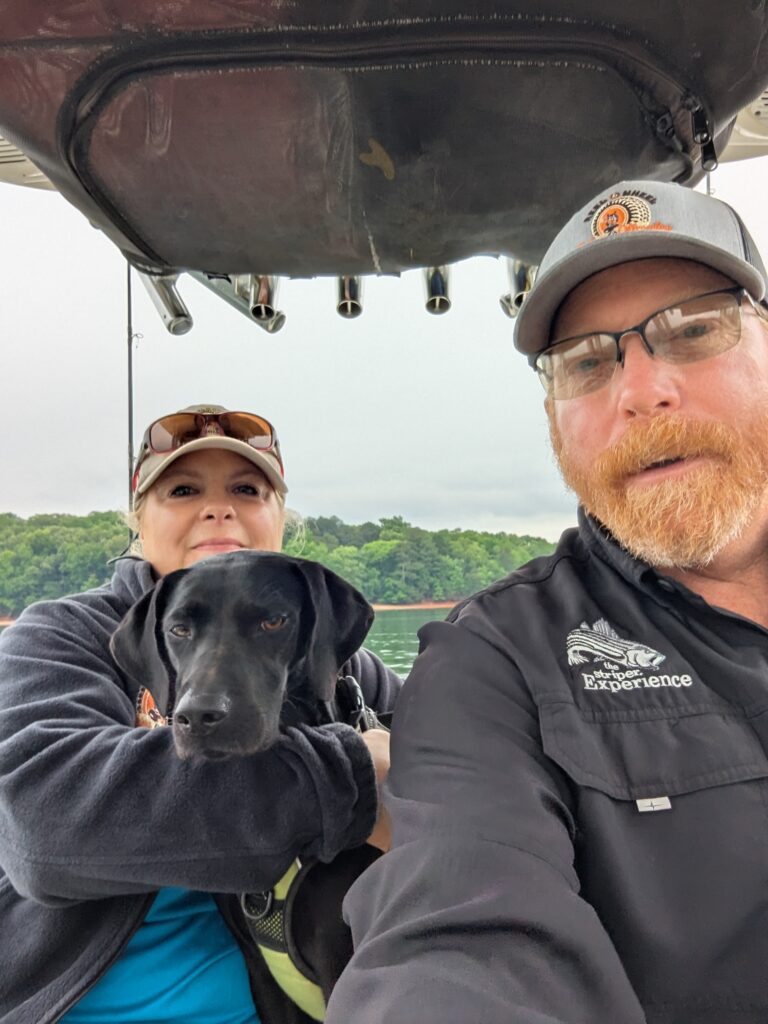
This is Gia. She’s 40 pounds, she is fully convinced she’s a lapdog, and she has opinions about being left behind. She rides in the boat, the Jeep, and the motorhome. She barks from the moment we start the engine until we’re actually moving, every single time, like the departure won’t count unless she announces it.
We didn’t set out to become people who travel everywhere with their dog. It happened one trip at a time – day trips, then a four-week road trip two years ago, and this fall, three weeks across eight states. Most of what we know now we learned by getting something wrong first. If you’re thinking about bringing your dog into this lifestyle – fishing, offroading, long road trips – here’s what actually works for us, and where the honest limits are.
The Baseline: What Comes With Her Every Time
Whether it’s a day on the lake or three weeks on the road, the same core kit travels with Gia. Building this list once, and keeping it packed, is the single thing that made dog travel feel routine instead of like a production.
- Water and a bowl that lives in the vehicle – not one we remember to grab. Dogs overheat faster than people, and thirst shows up before you expect it.
- Vet records and vaccination proof. Some campgrounds and parks ask. Most don’t. The one that does will ask on the day you left the folder at home.
- A leash and a backup leash, because the primary one is always wherever Gia last decided it should be.
- Food portioned for the trip plus extra days. Running out of your dog’s specific food in a small town is a solvable problem, but not a fun one.
- Something that smells like home – her bed. It matters more than any of the gear.
On the Boat
Gia is, as Ron puts it, a bird dog. She does not care about fish. She cares deeply about birds, splashes, and anything that moves along the bank, which makes a fishing boat either the best seat in the house or a test of everyone’s patience depending on the day.
What we’ve learned: shade and traction are the whole game. A dog on a hot deck with nowhere to grip is a miserable dog, and a miserable dog makes for a short trip. She has a spot that’s hers, out of the way of rods and nets, and getting her to actually stay in it took repetition, not one good talking-to.
The tradeoff nobody mentions: a dog on the boat changes how you fish. Hooks, live bait, and a curious nose are a bad combination, so somebody is always half-watching her. We’ve decided she’s worth it. Some days, mid-cast, Ron would like to reopen the discussion.
On the Trail
Gia rides in the Jeep on easier trails, and she stays back for the technical ones. That line took us a while to draw honestly, because she wants to come every time and it’s easy to let the sad eyes make the decision.
Here’s how we actually decide: if the trail is rough enough that we’re thinking about the best lines to stay safe, she doesn’t come. A dog can’t brace for what it can’t predict, and she has no way to know a hard flex is coming. On the trails she does join, she’s secured – a loose dog in an open Jeep is one startled squirrel away from a very bad day. This is a dog who chases anything that runs. We plan accordingly.
Heat is the other hard rule. Rock and sand hold heat long after the air feels fine, and paws are not boots. Summer trail days, she stays somewhere cool and we take the guilt.
In the Motorhome
The motorhome is where Gia is most convinced the whole operation was designed for her. Forty pounds of dog takes up a surprising percentage of a motorhome, especially when that dog believes her assigned seat is your lap.
Two years ago we took her on a four-week trip, and it taught us most of what we know about long stretches on the road. The biggest lesson: she’s remarkably adaptable as long as she’s with us. Within a few days she had settled her own routine – when to eat, when to potty, how to handle hours a day of driving. We didn’t build the routine for her. We just kept the days consistent and she built it herself.
The second lesson was the one we didn’t see coming: leash walks weren’t enough. A dog who spends hours a day in a motorhome needs to actually run, off leash, and that doesn’t happen by accident. We started planning for it – campgrounds with dog parks, fuel stops with dog runs, anywhere she could burn energy free of the leash. It became a real routing factor, the same way fuel stops are.
The third: motorhome days need breaking up. Days in the Jeep or on the boat took her attention and energy in a way riding shotgun never did. A tired, engaged dog is an easy travel companion. A dog who’s done nothing but ride is not.
And yes – the departure bark still happens every time we pull out. Four weeks didn’t cure it. We’ve stopped fighting it. Some things are not training problems. Some things are personality.
Round Two: Three Weeks This Fall
This fall is Gia’s second long haul – three weeks in the motorhome, eight offroad parks across eight states, and weather that could run from Texas heat to near-freezing mornings at the North Rim of the Grand Canyon. The four-week trip proved she can do the road. What’s new this time is everything around the road: other couples along, more wheeling days than she’s ever had in one trip, and a wider weather swing than she’s ever traveled through.
So her prep this time isn’t guesswork. It’s the system the last trip taught us, on the master checklist like everything else:
- Off-leash stops mapped along the route – campgrounds with dog parks, fuel stops with dog runs. We learned the hard way that this can’t be left to chance, so now it’s part of route research, not something we hope to find.
- Jeep and boat days spaced through the trip so she’s not stacking motorhome days back to back. Her energy budget is part of the schedule now.
- Food math for 21 days, packed with margin, because her food is not guaranteed to be on a shelf in rural New Mexico.
- Vet records in a folder, plus a check on which stops require proof of vaccination.
- A plan for trail days she can’t join – who stays back, or how we keep the motorhome cool and the timeline short. Traveling with a dog means some days get shaped around her.
- Her spot: same bed, same location in the motorhome, from night one. The road changes daily. Her corner of it doesn’t.
Ron’s assessment is that she’ll settle in by day two, and last time he was right almost to the hour. I’ll still be watching her closer than the weather. That’s the arrangement: he stays calm, I keep the list, and Gia remains unbothered by both of us.
The Honest Part
Traveling with a dog is not free. It rules out some restaurants, some trails, and some spontaneous plans. It adds a line to every checklist and a variable to every day. If you’re deciding whether to bring yours, that’s the real cost, and it’s fair to weigh it.
For us it stopped being a decision a long time ago. The trips are better with her in them, even the ones she complicates. Especially those, honestly. The departure bark is the sound of the trip starting.
| Traveling with your own dog? The Trip Ready Planner inside our Adventure Together Pack has built-in pet sections – food math, records, and the checklist items that are easy to forget until you’re three states from home. It’s the same planner Gia’s Fall trip prep lives in right now. |
